
It links clinical documentation with precise billing and reimbursement; medical coding is essential to healthcare operations. Traditional coding techniques are finding it difficult to keep up with growing data volumes, regulatory changes, and compliance requirements as healthcare systems become more complex. This is where automation and artificial intelligence come into play, making medical coding a quicker, more intelligent, and more dependable process. Medical coding in the future will be intelligent and technology-driven rather than manual.
The Need for Innovation in Medical Coding
Relying on traditional medical coding procedures presents a number of difficulties for healthcare providers. Coders must manage demanding workloads while staying current with changing ICD, CPT, and HCPCS codes. Claim denials, payment delays, or compliance issues can result from even minor coding errors.
Healthcare organizations are also under pressure to find effective alternatives due to staffing shortages and growing administrative expenses. The need for automated, AI-powered solutions that lower errors and boost overall productivity is highlighted by these difficulties.
An Explanation of AI-Powered Medical Coding
Clinical documentation is interpreted by AI-powered medical coding systems using natural language processing (NLP) and machine learning algorithms. To automatically assign the most accurate codes, these technologies examine diagnostic reports, discharge summaries, and doctor's notes.
AI systems continuously learn from past data, in contrast to manual coding. They improve accuracy and consistency over time by adjusting to payer requirements, coding patterns, and regulatory updates. Healthcare organizations can expand their operations without sacrificing quality thanks to this intelligence.
Automation and Optimization of Workflow
By automating time-consuming and repetitive tasks, medical coding is improved. Automated workflows guarantee quicker processing and fewer bottlenecks for everything from document review to code validation.
Among the main advantages of automation are: automatic detection of incomplete or missing documentation, validation of codes in real time prior to filing claims, smooth interaction with billing and EHR systems, and decreased rejections of claims because of technical mistakes.
Coders can concentrate on complex cases that call for clinical judgment when routine tasks are automated.
Principal Benefits of Automation and AI in Medical Coding
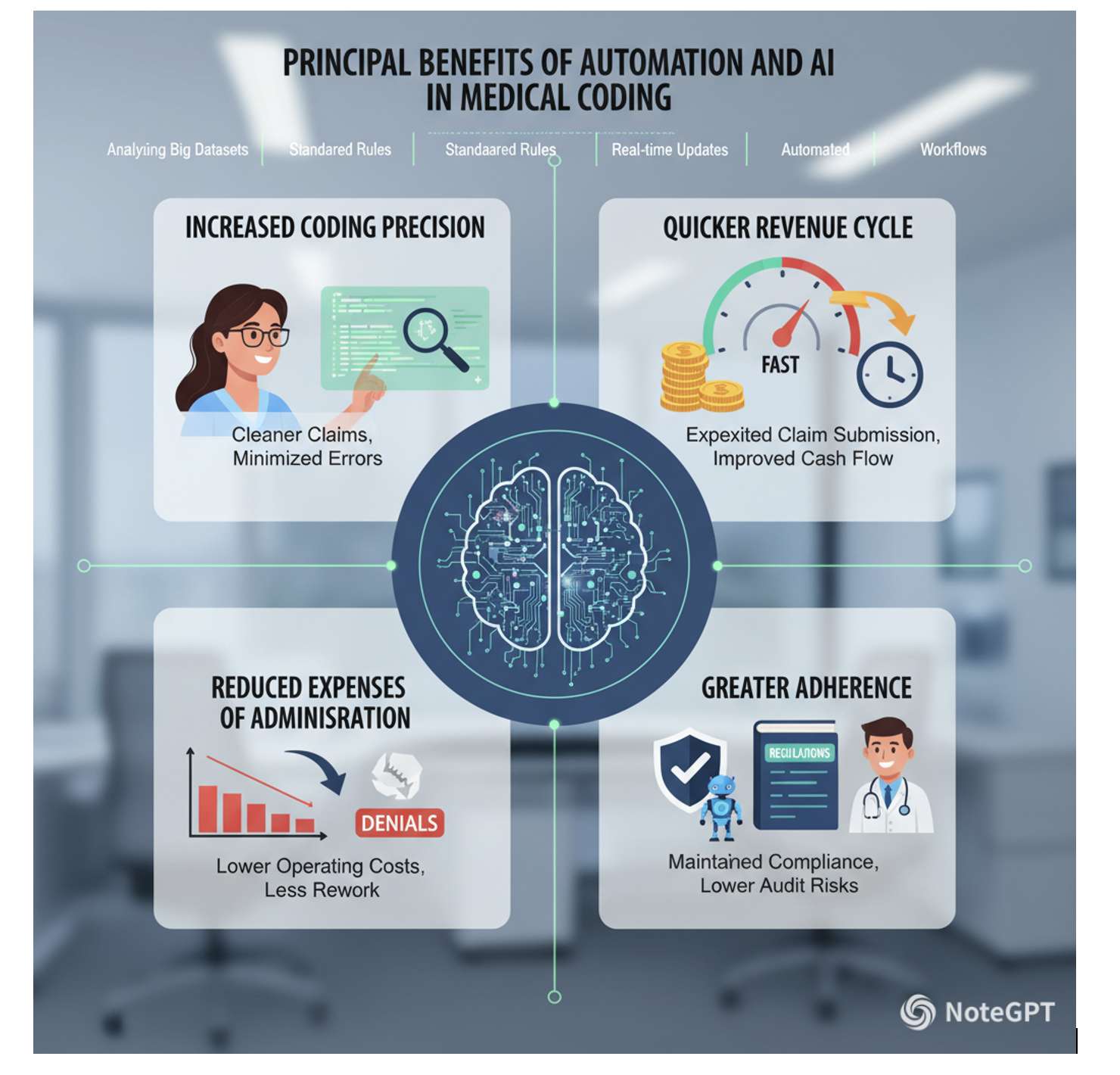
Increased Coding Precision By analyzing big datasets and adhering to standardized rules, AI systems minimize human error and produce cleaner claims.
Quicker Revenue Cycle Automated coding reduces reimbursement delays and improves cash flow by expediting claim submission.
Reduced Expenses of Administration Operating costs for healthcare organizations can be greatly reduced by reducing rework and denials.
Greater Adherence AI tools assist providers in maintaining compliance and lowering audit risks by keeping up with regulatory updates.
The Evolution of Medical Coders' Roles

Contrary to popular assumption, AI is changing the roles of medical coders rather than replacing them. Auditing, compliance monitoring, and managing intricate medical situations still require human expertise. In order to ensure accuracy and direct system enhancements, programmers are becoming AI supervisors and quality assurance specialists.
This human-technology collaboration produces better results and more effective healthcare operations.
Emerging Patterns in Medical Coding Technologies
Medical coding will continue to advance in the future thanks to cutting-edge innovations like: AI-assisted real-time coding while documenting patients, using predictive analytics to stop claim rejections, platforms for cloud-based coding that are scalable, and improved compatibility of data between healthcare systems.
These developments will improve healthcare providers' financial sustainability and reinforce revenue cycle management.
Conclusion
By improving accuracy, efficiency, and compliance, artificial intelligence (AI) and automation are transforming medical coding in the future. Healthcare organizations can improve overall performance, expedite reimbursements, and lessen administrative burdens by implementing intelligent coding solutions. Those who embrace innovation will have the best chance of building a more intelligent and robust medical coding ecosystem by fusing AI technology with human knowledge.


